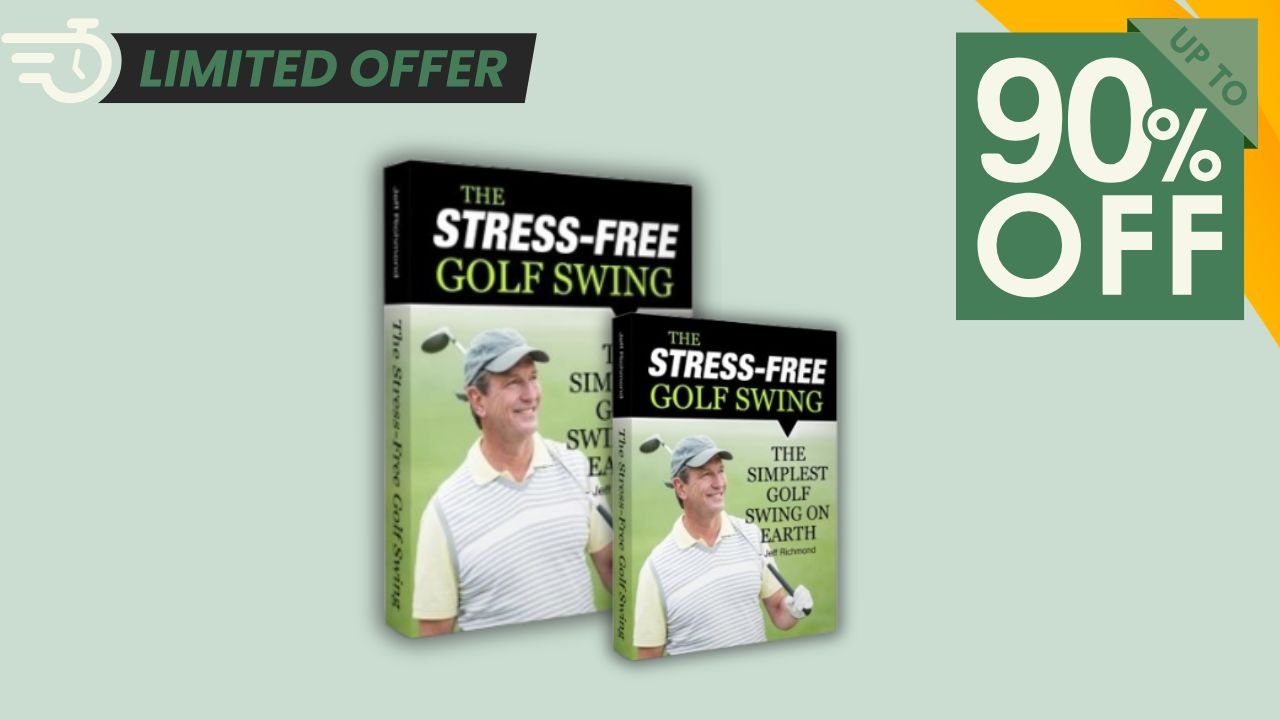
The Stress-Free Golf Swing Reviews and Complaints 2026
The Stress-Free Golf Swing Reviews: Another golf program promises easier ball striking and lower scores.
Your first reaction may be, “Here we go again.”
That reaction becomes stronger after years of failed swing fixes.
You tried lessons, YouTube videos, gadgets, and endless practice drills.
Yet one bad round still sends your confidence crashing.
So why should The Stress-Free Golf Swing deserve another dollar?
Do not answer that question yet.
Instead, work through these ten questions in order.
Your answers should tell you whether this $67 system makes sense.
| Feature | Details |
|---|---|
| Product Name | The Stress-Free Golf Swing |
| Creator | Jeff Richmond |
| Product Type | Digital golf swing training system |
| Core Method | One Ben Hogan-inspired swing movement |
| Main Goal | Better contact, consistency, distance, and ball striking |
| PDF Manual | 169 pages |
| Training Videos | 21 step-by-step online videos |
| Quick Guide | One-page Quick-Start Cheat Sheet |
| Current Listed Price | $67 |
| Previous Listed Prices | $127 and $197 |
| Delivery Method | Instant digital access |
| Refund Period | 60-day money-back guarantee |
| Practice Requirement | Short home, range, and course drills |
| Reported Benefits | Better contact, fewer misses, more distance, lower scores |
| Best Suited For | Golfers tired of confusing swing tips |
| Senior Friendly | Designed without demanding extreme strength or flexibility |
| Main Concern | Whether one movement can create meaningful improvement |
| Risk Factor | Poor practice may make the movement harder to learn |
| Buying Tip | Follow the official purchase route shown by the seller |
Question 1: Have More Golf Tips Actually Made Your Swing Better?
Think about how much golf advice you already know.
You probably understand grip, posture, rotation, tempo, and weight transfer.
You may also know several popular fixes for slicing.
Yet knowing those ideas does not guarantee good contact.
That creates an uncomfortable question.
If more information solved everything, why are you still searching?
Many frustrated golfers have too much information already.
They watch one lesson after every poor round.
A slice leads to another grip video.
A fat iron leads to another weight-transfer drill.
A weak drive creates another search for clubhead speed.
Soon, five different swing thoughts compete during one shot.
That becomes a serious problem during real golf.
You cannot consciously manage every body part during your downswing.
The motion simply happens too quickly.
The Stress-Free Golf Swing takes the opposite approach.
It builds the system around one main movement.
You practice that movement until it becomes familiar.
Then you carry one primary thought onto the course.
Would another ten swing tips solve your current problem?
Or would one reliable movement give you a clearer direction?
If complexity already failed, adding complexity makes little sense.
That takes us directly to the next question.
Question 2: Would One Trusted Swing Thought Help Under Pressure?
Remember one of your best recent rounds.
Did you spend every shot checking six technical positions?
Probably not.
Good rounds often feel simple.
You choose your target and make a committed swing.
Now remember your worst recent round.
One bad drive probably created another swing thought.
The next miss added another correction.
By hole twelve, your natural swing disappeared completely.
Pressure makes this problem even worse.
Imagine needing one solid drive on the eighteenth hole.
Would five mechanical thoughts make that moment easier?
Or would one trusted movement give you more confidence?
The answer matters because golf rewards repeatable movement.
The Stress-Free Golf Swing focuses heavily on this point.
Jeff Richmond teaches one Hogan-inspired movement as the main foundation.
The supporting lessons help golfers understand that movement.
However, the main idea stays simple.
You are not juggling several commands before impact.
You are building one motion that becomes easier through repetition.
That simplicity can become especially valuable during competitive rounds.
Pressure rarely makes complicated instructions easier to remember.
It usually exposes every doubt hiding inside your swing.
Would one familiar thought create less tension?
Would less tension make commitment easier?
Would stronger commitment improve your chances of cleaner contact?
Your answers naturally lead toward the third question.
Question 3: Do You Really Want To Rebuild Your Entire Swing?
Many golfers fear major swing changes.
That fear makes sense.
You already built your movement over many years.
Replacing everything could require months of uncomfortable golf.
Few recreational players want that experience.
Most golfers want improvement without starting again.
The Stress-Free Golf Swing targets that exact desire.
The program does not ask you to copy Hogan completely.
It focuses on adding one movement into your existing swing.
That distinction matters more than it first appears.
Suppose you play golf every second weekend.
Could you realistically rebuild your whole swing?
You may not have enough range time.
You may not want months of terrible contact either.
One focused adjustment becomes far easier to practice.
The program also provides setup guidance around the movement.
It covers grip, posture, and address where needed.
Those lessons support the central move.
They do not turn the program into endless technical positions.
Now ask yourself what you actually want.
Do you want a completely different golf swing?
Or do you want your current swing working more consistently?
For most weekend golfers, that answer comes quickly.
Question 4: Do Specific Results Tell You More Than Marketing Claims?
Anyone can write “amazing results” on a sales page.
Specific stories deserve more attention.
The Stress-Free Golf Swing page includes several detailed examples.
Steve Mitchell was 69 and played from a 16 handicap.
He reported gaining fifteen yards with his seven-iron.
He also reported removing fat shots from his normal pattern.
Joe Adams described himself as a regular 90 shooter.
He reported shooting 80 after five days using the method.
Glen Miller previously reported scores around 85 to 90.
He later reported rounds between 79 and 84.
Other golfers describe different changes.
Some mention fewer slices and stronger draws.
Others mention cleaner iron contact and improved confidence.
One golfer describes handling pressure better during club competition.
Why does that variety matter?
Real golfers rarely struggle with exactly the same problem.
A 72-year-old shanker needs something different from a chronic slicer.
A 90 shooter may care more about basic consistency.
A lower handicapper may care about tighter misses.
Yet better movement can influence each golfer differently.
Would identical testimonials from everyone feel more believable?
Probably not.
Different golfers reporting different gains fits normal golf better.
That leads toward another important question.
Question 5: Would Better Ball Striking Make Your Whole Round Easier?
Think about what happens after a terrible drive.
Your next shot becomes damage control.
Now think about a fat approach shot.
You still need another shot before reaching the green.
Poor contact creates extra work throughout the entire round.
Better contact changes that pattern.
A stronger drive gives you an easier second shot.
A solid iron travels closer to its expected distance.
A reliable approach gives you more chances at pars.
That is why this system focuses heavily on ball striking.
It also connects better striking with more Greens in Regulation.
The logic becomes very simple.
Hit better shots.
Reach more greens.
Face fewer difficult recovery shots.
Give yourself more chances for comfortable pars.
Your short game still matters.
However, constant scrambling makes good scoring much harder.
Imagine hitting three more greens during your next round.
Would that remove some pressure from your chipping?
Would it reduce those desperate bunker saves?
Would putting for par feel easier than scrambling for bogey?
You probably already know those answers.
So what deserves more attention?
Another tiny putting trick?
Or better contact with the clubs used throughout every hole?
Question 6: Can A Simple Idea Still Need Detailed Teaching?
“One movement” can sound almost too simple.
That does not mean one paragraph teaches it properly.
Golfers must understand what a movement should feel like.
They also need to recognize common mistakes.
The Stress-Free Golf Swing provides several teaching formats.
The package includes a 169-page PDF manual.
It also includes 21 step-by-step videos.
Buyers receive a one-page Quick-Start Cheat Sheet.
The modules move through the method in stages.
You learn the Hogan-inspired idea first.
Then you learn the movement itself.
Setup lessons help support the new motion.
Feel drills help you practice without hitting balls.
Range lessons help transfer practice into real shots.
Another section addresses common misses.
The final material provides a 7–14 day implementation plan.
Why include so much material for one movement?
Because understanding something does not mean performing it correctly.
You might understand the words immediately.
Your body may still produce an old movement.
Videos help you see the difference.
Drills help you feel the difference.
Repeated practice helps make that difference familiar.
Would you rather receive one vague “secret move” paragraph?
Or would you prefer detailed instructions around one clear idea?
That question makes the package easier to judge.
Question 7: Does Your Limited Practice Time Make Simplicity More Valuable?
Most amateur golfers have busy lives.
Work does not disappear because your driver started slicing.
Family commitments also compete with practice time.
That makes every practice minute important.
Suppose you have ten minutes tonight.
Could you realistically work through seven complicated swing positions?
Probably not.
Could you rehearse one movement several times?
That sounds much easier.
The program includes short feel drills for home practice.
You do not always need golf balls.
You do not always need a driving range.
You can practice certain movements inside your living room.
You can also rehearse them inside your backyard.
Then you can test the feel during your next session.
This approach becomes useful for older golfers too.
Several featured golfers are in their sixties and seventies.
Many older players do not want exhausting practice sessions.
They want cleaner contact without forcing extra speed.
Short, focused practice fits that goal better.
Now compare two options.
One demands constant range visits and several swing changes.
The other focuses on one movement with short practice drills.
Which option actually fits your weekly schedule?
Your calendar probably answers that question better than any review.
Question 8: What Are You Really Getting For $67?
Price means nothing without context.
The current sales page lists the system for $67.
So what does that payment actually buy?
You receive the 169-page digital manual.
You receive 21 online training videos.
You receive the Quick-Start Cheat Sheet.
You receive setup guidance and practice drills.
You also receive help moving the change onto courses.
Now compare $67 with normal golf spending.
How much does one round cost at your local course?
How much does one private golf lesson cost?
How much have you spent testing golf balls?
What about training aids sitting unused inside your garage?
Many golfers have already wasted more than $67.
A new gadget may affect one small part of practice.
A movement change can affect several clubs inside your bag.
Your driver uses your swing.
Your irons use your swing.
Your hybrids use your swing.
Your wedges also depend on reliable contact.
If one movement improves several full shots, what creates greater value?
Another accessory?
Or a skill that follows you across your golf bag?
That question changes how the $67 price looks.
Question 9: Does A 60-Day Guarantee Change The Buying Risk?
Nobody wants another digital program gathering virtual dust.
That concern deserves attention.
The seller lists a 60-day money-back guarantee.
That gives you time to test the method properly.
You can read the guide.
You can watch the videos.
You can practice the drills.
Then you can track what happens during real rounds.
Create a simple test before changing anything.
Write down your average recent score.
Track how many greens you normally hit.
Notice how often fat shots appear.
Watch how many drives create major trouble.
Then follow the program consistently.
Track the same numbers again.
Would those results tell you more than another stranger’s review?
Absolutely.
Your own scorecard gives you personal evidence.
Your ball flight gives you another form of evidence.
Your normal misses provide even more information.
The guarantee provides a window for that testing process.
Now compare the alternatives.
One option involves testing one clear system carefully.
The other involves continuing random fixes without any clear plan.
Which choice gives you better information?
That answer leads directly into the final question.
Question 10: What Happens If You Keep Doing Exactly The Same Thing?
Picture yourself playing golf twelve months from now.
You still watch a new lesson after every bad round.
You still change swing thoughts every few weeks.
Some days your driver behaves.
Other days it disappears completely.
Your irons remain unpredictable under pressure.
You still cannot explain why good rounds happen.
Would you feel happy with that situation?
Now picture a different year.
You choose one movement and practice it consistently.
You stop changing your swing after every miss.
You measure contact instead of chasing feelings.
You track greens and scoring over several rounds.
You finally give one approach enough time to become familiar.
Would that create a better chance of lasting improvement?
You already know your answer.
That answer did not come from Jeff Richmond.
It did not come from another golfer’s testimonial.
It came from your own experience with your golf game.
You know what endless tip chasing has produced.
You also know what one focused test would cost.
You know the package contains detailed training material.
You know the seller lists a 60-day guarantee.
So one final decision remains.
Would another year of confusion cost you more than testing one clear system?
If your answer feels clear, act on that answer.
Follow the program carefully and track your own golf results.
Frequently Asked Questions
Is The Stress-Free Golf Swing worth $67?
That depends on what better contact means for your game.
The package includes a manual, videos, drills, and quick guide.
Compare that price with one lesson or another training aid.
Then decide which option gives you more useful practice.
Is The Stress-Free Golf Swing suitable for senior golfers?
The program targets golfers across several age groups.
Its featured stories include golfers in their sixties and seventies.
The core method does not demand extreme strength or flexibility.
That makes it appealing for many older recreational golfers.
How quickly can I learn The Stress-Free Golf Swing?
Some featured golfers report early changes in their ball striking.
Others describe improvements after several weeks of practice.
The program includes short drills for building the movement gradually.
Give the method enough practice before judging your results.
Do I need to rebuild my current golf swing?
The program does not focus on rebuilding everything.
It aims to add one core movement into your swing.
Setup lessons support that movement where needed.
That approach may feel easier than starting completely again.
What if The Stress-Free Golf Swing does not help?
The seller advertises a 60-day money-back guarantee.
Use that period to test the system seriously.
Track contact, greens, misses, and scores during your trial.
Your own results should guide your final decision.