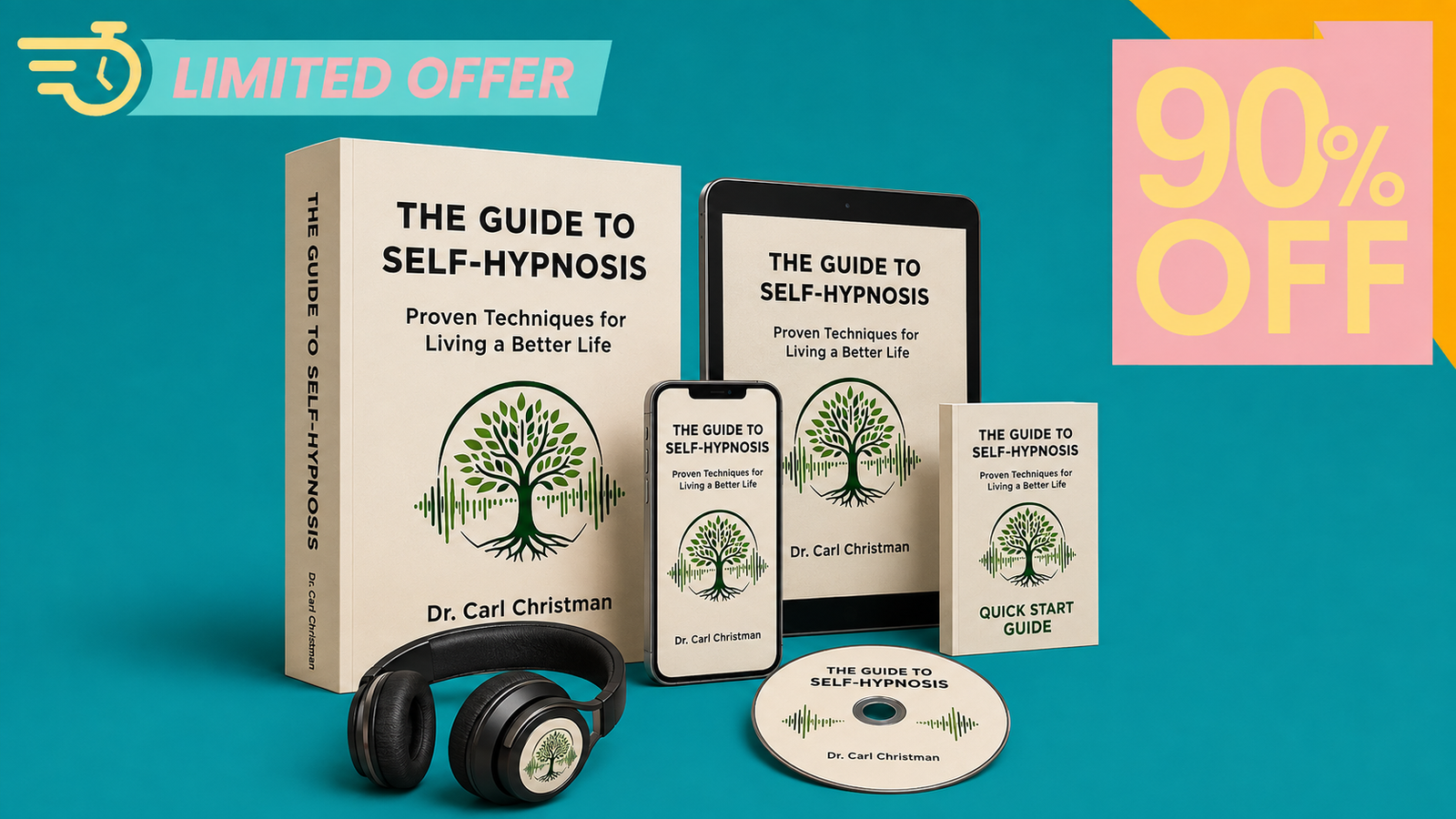
The Guide to Self-Hypnosis Reviews
The Guide to Self-Hypnosis Reviews: Falling asleep feels impossible when your mind refuses to slow down.
The Guide to Self-Hypnosis Reviews may appear during that exact search.
You feel tired, but thoughts keep jumping from problem to problem.
Bills appear. Tomorrow’s work appears. Old conversations return without warning.
Then you check the clock and make yourself even more tense.
Could self-hypnosis make those twenty minutes before sleep feel calmer?
That question deserves a practical answer, not another dramatic sleep promise.
The Guide to Self-Hypnosis Reviews should therefore focus on the method.
They should explain what happens before asking you to believe anything.
| Feature | Details |
|---|---|
| Product Name | The Guide to Self-Hypnosis |
| Author | Dr. Carl Christman |
| Product Type | Digital self-hypnosis guide |
| Main Focus | Sleep, stress, confidence, motivation, habits, and wellness |
| Sleep Approach | Relaxation, focused attention, imagery, breathing, and suggestions |
| Listed Price | $19.95 |
| Regular Price Shown | $29.95 |
| Guided Audio Sessions | Six complimentary sessions |
| Sleep Audio | Sleep & Relaxation |
| Other Audio Topics | Stress, confidence, motivation, wellness, and habits |
| Extra Bonus | Free progress workbook |
| Access Type | Instant digital access |
| Reading Format | Mobile-friendly digital book |
| Main Sleep Goal | Build a calmer bedtime routine |
| 20-Minute Claim | A practical routine window, not a guaranteed sleep time |
| Money-Back Guarantee | 60 days |
| Reviews Shown | Positive customer comments appear on the sales page |
| Important Limitation | Customer reviews cannot guarantee personal results |
| Best For | Beginners wanting structured self-hypnosis guidance |
| Trust Factor | The page avoids describing hypnosis as magic or mind control |
Can Self-Hypnosis Help You Fall Asleep Within 20 Minutes?
Self-hypnosis may support sleep by helping you relax before bedtime. You slow your breathing, release muscle tension, narrow your attention, and use calming images. A twenty-minute routine creates time for this process. However, no method can promise that every person will fall asleep within exactly twenty minutes.
That difference matters.
The goal is not forcing sleep within a strict countdown.
The goal is making those first twenty minutes calmer and less frustrating.
The Guide to Self-Hypnosis Reviews: Why Skeptical Readers Have Real Questions
The toughest reader has probably tested many sleep tricks already.
Maybe breathing exercises worked for three nights, then stopped helping.
Maybe meditation felt harder than expected.
Perhaps white noise became another sound keeping them awake.
Another sleep product can therefore feel like another polished sales pitch.
Readers checking The Guide to Self-Hypnosis Reviews may think:
- “Hypnosis sounds fake or theatrical.”
- “My mind never switches off that easily.”
- “I cannot force myself into hypnosis.”
- “Twenty minutes sounds too good to be true.”
- “I already tried relaxation exercises.”
- “Positive reviews cannot predict my results.”
- “I do not want anyone controlling my thoughts.”
- “I need sleep, not another complicated routine.”
Those doubts matter because hypnosis often carries strange myths.
The book takes a much simpler position.
It describes self-hypnosis as focused attention and guided relaxation.
You stay aware and maintain control during the process.
That makes The Guide to Self-Hypnosis Reviews easier to judge fairly.
You can focus on the steps instead of television-style hypnosis myths.
So, what should you ask before trying this approach?
What Keeps You Awake When You Try to Sleep?
Think about your first minutes after getting into bed.
Is your body moving, or is your mind still working?
Many restless nights involve thoughts that demand constant attention.
You remember tomorrow’s meeting.
Then you replay something awkward from earlier.
Next, you calculate how many hours remain before morning.
That pressure can make sleep feel like another task.
Readers searching The Guide to Self-Hypnosis Reviews often want relief here.
They want something that helps them stop chasing sleep.
Self-hypnosis changes the immediate goal.
Instead of demanding sleep, you focus first on becoming calmer.
The guide uses breathing, focused attention, imagery, and gentle suggestions.
Those tools give your attention somewhere quieter to go.
Ask yourself something simple.
If busy thoughts keep you awake, could calmer focus help?
Can Relaxing Your Body Make Falling Asleep Easier?
Notice your body during a stressful evening.
Your shoulders rise.
Your jaw tightens.
Your breathing may become quick or shallow.
Those signs hardly create a peaceful bedtime.
Now picture the opposite.
Your shoulders loosen.
Your breathing slows.
Your hands and legs feel heavier.
Would that state feel more suitable for sleep?
The Guide to Self-Hypnosis Reviews should explain this basic connection.
Self-hypnosis often starts by helping the body settle.
You might breathe slowly while relaxing one muscle group at once.
You might picture warmth moving through your arms and legs.
Nothing magical needs to happen.
You simply create fewer reasons for your mind to stay alert.
The book also discusses preparing your environment before each session.
Comfort, timing, surroundings, and goals all matter.
That practical setup strengthens The Guide to Self-Hypnosis Reviews for beginners.
The process starts with ordinary actions people can understand.
So, which feels more sleep-friendly?
A tight body or a relaxed one?
Can Self-Hypnosis Stop Racing Thoughts at Night?
Try telling yourself not to think about tomorrow’s biggest problem.
Your mind will often return directly to that problem.
Then you become annoyed because the thought remains.
That creates another layer of stress.
Self-hypnosis takes a different route.
Instead of fighting thoughts, you redirect your attention.
Readers exploring The Guide to Self-Hypnosis Reviews should notice this difference.
You might focus on breathing.
You might count slowly.
You could picture ten steps leading downward.
Each step becomes connected with greater calm.
The goal is not making every thought disappear.
The goal is giving your attention a quieter target.
Imagine two choices.
You can fight every thought entering your head.
Or you can repeatedly guide your attention somewhere calmer.
Which one sounds less exhausting?
Does Mental Imagery Really Affect Relaxation?
Imagine cutting a fresh lemon.
Picture the juice reaching your tongue.
You may notice your mouth respond to that imagined taste.
The lemon is not actually there.
Yet the image can still create a small physical reaction.
Mental rehearsal works in other situations too.
Athletes often picture movements before performing them.
Speakers may imagine giving a calm presentation.
The Guide to Self-Hypnosis Reviews should consider this part of the method.
Self-hypnosis uses mental pictures as part of focused relaxation.
You might imagine warmth, heaviness, safety, quiet, or peaceful surroundings.
You might picture yourself waking after a restful night.
The guide does not claim imagination controls everything.
Instead, it uses imagery as one tool within a wider routine.
That makes The Guide to Self-Hypnosis Reviews more useful than simple hype.
The reader can judge a clear technique instead of vague promises.
Could peaceful imagery feel better than rehearsing tomorrow’s worries?
That answer may tell you something important.
Does Practicing Self-Hypnosis Make Bedtime Easier?
Think about learning to drive.
At first, every action required attention.
Later, many movements became familiar.
Typing works the same way.
The first attempts feel slow.
Practice eventually makes the process easier.
Relaxation may also become easier with repetition.
The Guide to Self-Hypnosis Reviews should not present one session as magic.
The guide instead presents self-hypnosis as a learnable skill.
Your first session may require more effort.
Later sessions may feel more familiar.
Repeated practice can also give bedtime a predictable pattern.
Morning coffee can signal the start of work.
Workout clothes can signal exercise.
A repeated bedtime routine may also become a useful cue.
This makes consistency important within The Guide to Self-Hypnosis Reviews.
Jumping between new sleep hacks gives you no stable pattern.
Using one routine lets you see whether practice changes anything.
Would one repeated process make more sense than nightly experiments?
Can Clock Watching Make Sleep Anxiety Worse?
Imagine checking your phone every few minutes.
First, you see 11:42 p.m.
Later, the clock says 12:08 a.m.
Then it reaches 12:37 a.m.
Now you start calculating tomorrow’s remaining sleep.
Every check creates another reason to worry.
A twenty-minute relaxation routine offers another approach.
You give yourself time to settle without constant clock watching.
This distinction belongs in honest The Guide to Self-Hypnosis Reviews.
The guide cannot guarantee sleep within exactly twenty minutes.
Sleep varies between people and between nights.
Stress can change it.
Caffeine can change it.
Daily schedules can change it.
Health issues can also affect sleep.
Therefore, twenty minutes works better as a routine window.
You use that period for relaxation instead of measuring every minute.
That makes The Guide to Self-Hypnosis Reviews more realistic.
The method aims to reduce pressure, not create another deadline.
Would less clock watching make bedtime feel easier?
Does The Guide to Self-Hypnosis Give Clear Sleep Instructions?
Search online and you will find hundreds of sleep tricks.
Count backward from one thousand.
Picture clouds.
Breathe using a certain pattern.
Clear your mind completely.
Trying something new every night can become tiring.
The Guide to Self-Hypnosis Reviews should therefore examine structure.
The guide begins by explaining hypnosis and common myths.
It then covers preparation for a self-hypnosis session.
Readers learn a complete session from beginning to end.
Later sections cover deepening methods and effective suggestions.
The book also discusses breathing, imagery, affirmations, and mental rehearsal.
Readers receive six guided audio sessions too.
One session focuses directly on sleep and relaxation.
That gives beginners something they can follow immediately.
Structure matters because exhausted people rarely want more decisions.
A clear routine removes much of that guesswork.
This is one useful point within The Guide to Self-Hypnosis Reviews.
You know the next step instead of hunting for another technique.
Would one clear sequence feel easier than ten random sleep hacks?
Do You Need to Believe in Self-Hypnosis Before Trying It?
Some people think hypnosis requires complete belief.
It does not need to be approached that way.
You do not need strong beliefs before taking slow breaths.
You simply breathe and notice what happens.
You can approach self-hypnosis with the same mindset.
That matters when reading The Guide to Self-Hypnosis Reviews.
You can remain skeptical while testing the routine.
You can practice for several nights.
You can notice whether your body settles faster.
You can notice whether thoughts feel less demanding.
You can stop if the approach does not suit you.
The book also rejects the idea of mind control.
You remain involved and choose the suggestions you use.
That trust point strengthens The Guide to Self-Hypnosis Reviews.
Nobody needs to surrender control or believe something supernatural.
You are testing a structured relaxation skill.
Would curiosity be enough to try that?
Can a 20-Minute Self-Hypnosis Routine Replace Bedtime Scrolling?
Picture a difficult bedtime.
You cannot sleep, so you reach for your phone.
Five minutes becomes twenty.
Twenty minutes becomes forty.
You keep feeding your mind new videos, messages, and information.
Now picture another routine.
You put your phone away.
You make the room quieter.
You settle into a comfortable position.
Then you follow one calming sequence.
Readers looking for The Guide to Self-Hypnosis Reviews may prefer this simplicity.
The process gives those restless minutes a clear purpose.
Instead of scrolling, you practice slowing down.
Which routine looks more likely to settle an active mind?
How to Use a 20-Minute Self-Hypnosis Sleep Routine
Here is a simple example based on the methods described.
The Guide to Self-Hypnosis Reviews should make this process easy to picture.
Minutes 1-3: Prepare for Sleep
Put your phone away.
Reduce unnecessary light.
Lie comfortably and let your breathing settle.
Do not start measuring results yet.
Minutes 4-7: Relax Your Body
Release tension from your face.
Then relax your shoulders, arms, hands, and legs.
Let each area soften without forcing anything.
This physical relaxation supports the wider self-hypnosis routine.
Minutes 8-12: Focus Your Attention
Choose one simple focus.
You can follow your breathing.
You can count slowly.
You can picture one peaceful place.
If your mind wanders, gently return to that focus.
Minutes 13-16: Deepen Your Relaxation
Imagine walking slowly down comfortable stairs.
You could also imagine sinking gently into your mattress.
Connect each count with greater comfort.
Do not test whether you feel “hypnotized enough.”
Minutes 17-20: Use Calm Sleep Suggestions
Keep each suggestion short and believable.
You might repeat:
- “My body knows how to rest.”
- “I can let today finish now.”
- “Nothing needs solving tonight.”
- “Each breath brings more comfort.”
- “I can rest without chasing sleep.”
If sleep arrives earlier, simply let yourself drift.
You do not need to finish every step.
This routine helps explain the practical side of The Guide to Self-Hypnosis Reviews.
It turns self-hypnosis into actions anyone can understand.
What Do The Guide to Self-Hypnosis Reviews Say About the Audio Bonuses?
The guide includes six complimentary guided hypnosis sessions.
That adds practical value for readers who dislike creating scripts themselves.
The included topics cover:
- Sleep and relaxation
- Stress and anxiety support
- Confidence and self-esteem
- Motivation and success
- Weight loss and health habits
- Breaking unwanted habits
The sleep session matters most for this discussion.
It helps users follow a guided process without memorizing every step.
This feature deserves attention within The Guide to Self-Hypnosis Reviews.
Beginners may find audio easier than working alone immediately.
The workbook also gives readers a way to track progress.
That can help you compare several sessions instead of judging one night.
Are The Guide to Self-Hypnosis Reviews Based on Real Customer Feedback?
The product page shows several positive customer comments.
One customer says the daily affirmation tracks changed how they felt.
Another says a hypnotherapist recommended the tracks.
A third says they began skeptical but liked their experience.
Those comments add useful context.
However, they do not prove the same result for every buyer.
Strong The Guide to Self-Hypnosis Reviews should make that distinction clear.
Personal feedback describes one person’s experience.
It cannot predict exactly how quickly you will fall asleep.
The testimonials also discuss affirmation tracks broadly.
They should not become proof of a guaranteed twenty-minute sleep result.
That honesty matters when judging The Guide to Self-Hypnosis Reviews.
The product page itself uses softer language around sleep.
It says the methods support relaxation and a peaceful sleep transition.
That wording feels more trustworthy than promising instant results.
Is The Guide to Self-Hypnosis Legit or a Scam?
The sales page identifies Dr. Carl Christman as the book’s author.
It explains what buyers receive before purchase.
The listed digital price is $19.95.
A crossed-out regular price of $29.95 also appears.
Buyers receive the digital book, workbook, and six guided sessions.
The page also displays a 60-day money-back guarantee.
ClickBank acts as the retailer for the product.
These details help readers assess The Guide to Self-Hypnosis Reviews carefully.
The page also includes contact information and policy links.
It contains privacy, terms, and disclaimer pages.
Those details provide more context than an anonymous sales page would.
Still, buyers should judge the program by its actual claims.
The safest reading of The Guide to Self-Hypnosis Reviews remains simple.
It is a self-hypnosis learning resource, not guaranteed medical treatment.
The website describes the programs as relaxation and personal-development resources.
That trust statement deserves attention before anyone buys.
What Does The Guide to Self-Hypnosis Cost?
The product page lists the current price as $19.95.
The displayed regular price is $29.95.
The purchase provides instant digital access.
It does not describe the product as a physical paperback.
The book image serves as a visual mockup.
This detail belongs in accurate The Guide to Self-Hypnosis Reviews.
The package includes:
- The complete digital book
- Mobile-friendly access
- Six guided hypnosis sessions
- Practical exercises
- Step-by-step guidance
- A progress workbook
- A 60-day money-back guarantee
Someone comparing The Guide to Self-Hypnosis Reviews should judge that whole package.
Price alone does not tell you whether the method suits you.
The important question is whether you will actually practice it.
Who Should Consider The Guide to Self-Hypnosis?
The program may appeal to complete beginners.
It may also suit people wanting a structured relaxation routine.
Readers searching The Guide to Self-Hypnosis Reviews may value several features.
You do not need previous hypnosis experience.
The guide explains common myths first.
It walks readers through their first full session.
It provides guided recordings for extra support.
It also teaches users how to create personal suggestions.
People who dislike complicated systems may appreciate that structure.
However, The Guide to Self-Hypnosis Reviews should not oversell the fit.
Some people may simply dislike guided relaxation.
Others may prefer different sleep strategies.
The only useful test is whether the routine works for you.
What Would You Lose by Testing Self-Hypnosis Carefully?
Suppose you use the same routine for several evenings.
You begin around twenty minutes before your intended sleep time.
You avoid judging the method after three minutes.
Instead, you notice patterns across several attempts.
Maybe your body relaxes faster.
Maybe bedtime feels less frustrating.
Perhaps imagery works better than counting.
You might prefer audio guidance over creating your own suggestions.
Those observations give you useful personal information.
That is more valuable than blindly trusting The Guide to Self-Hypnosis Reviews.
The product also carries a 60-day money-back guarantee.
That gives buyers a stated refund period for evaluating the purchase.
You should still read the purchase terms before ordering.
Trust grows when expectations remain realistic.
The Guide to Self-Hypnosis Reviews: Final Verdict
The Guide to Self-Hypnosis Reviews should not convince you that twenty-minute sleep is guaranteed.
That would turn a practical method into another unrealistic promise.
The stronger reason to consider the guide is much simpler.
It gives restless bedtime minutes a clear structure.
You breathe.
You relax your body.
You narrow your focus.
You use peaceful imagery.
You repeat calm suggestions instead of watching the clock.
If your main problem involves racing thoughts and bedtime tension, that matters.
You do not need to believe in magic.
You only need to decide whether this routine deserves a fair test.
Read The Guide to Self-Hypnosis Reviews, check the official offer details, and decide whether you will actually use the method consistently.
Frequently Asked Questions About The Guide to Self-Hypnosis Reviews
What is The Guide to Self-Hypnosis?
The Guide to Self-Hypnosis is a digital book by Dr. Carl Christman.
It teaches focused attention, relaxation, imagery, breathing, and personal suggestions.
The Guide to Self-Hypnosis Reviews also highlight its six guided audio sessions.
The program focuses on personal development and relaxation.
Can The Guide to Self-Hypnosis Help Me Sleep Within 20 Minutes?
The program can support a calmer bedtime routine.
However, it cannot guarantee sleep within exactly twenty minutes.
The twenty-minute routine works best as a relaxation window.
How Much Does The Guide to Self-Hypnosis Cost?
The sales page lists the guide at $19.95.
It also shows a crossed-out regular price of $29.95.
The Guide to Self-Hypnosis Reviews should mention what buyers receive.
The package includes the book, workbook, and six guided audio sessions.
Does The Guide to Self-Hypnosis Include a Money-Back Guarantee?
Yes.
The product page displays a 60-day money-back guarantee.
Buyers should still review the current checkout terms before purchasing.
Accurate The Guide to Self-Hypnosis Reviews should include that important detail
Is The Guide to Self-Hypnosis Worth Trying for Better Sleep?
It may suit people who want structured bedtime relaxation.
The guide offers breathing, imagery, focused attention, and guided sessions.
It does not guarantee a specific sleep result.
Use The Guide to Self-Hypnosis Reviews to understand the offer.
Ilumnat Reviews 2026 USA: How To Achieve Deeper Spiritual Awareness